Showing posts with label walter benjamin. Show all posts

Monday, January 30, 2006

ruins

"Allegories," Walter Benjamin famously tells us, "are, in the realm of thoughts, what ruins are in the realm of things" (178). And, to turn the comparison around, it's no surprise that ruins have long been viewed as allegories: as always pointing beyond themselves, to some absent totality. Moreover that, at another level of abstraction, the gap itself between ruin and totality has itself been insistently conceived as some kind of second-order allegory. Allegory upon allegory, ruin upon ruin.

Benjamin's interest here is in the Baroque--though, more abstractly still, he is reading modernity through the Baroque, and the Baroque work of art as an allegory for the work of art in general. But it is with Romanticism that the ruin really comes into its own.

Or rather, the point of a ruin is the extent to which it falls short of "its own," the extent to which it is non-coincident with the structure that it implies. And Romanticism takes particular note of that discrepancy between the absent presence of the material trace and the present absence of the sublime that it invokes in its very default.
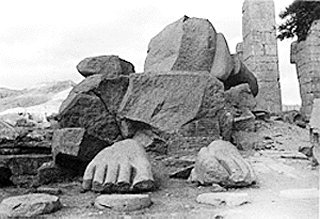
OzymandiasIn invoking totality and sublimity, ruins have been read as particularly vivid allegories of power and sovereignty--and their vicissitudes. Take, for instance, Shelley's "Ozymandias." Here the poet relates the tale of a traveller coming across a desert ruin, the toppled remains of a vast sculpture of power. On its pedestal
            these words appear:
"My name is Ozymandias, king of kings:
Look on my works, ye Mighty, and despair!"
Nothing beside remains. Round the decay
Of that colossal wreck, boundless and bare
The lone and level sands stretch far away. (11)
The levels of allegory and irony are complex. The inscription, for instance, with its injunction to despair, was presumably first intended to be interpreted in terms of the king's transcendent and overarching authority. Yet the mighty could now be tempted to despair for quite another reason: because in the fallen desolation of the broken monument they can perceive the temporary nature of even the most overweening despotism. But, in yet another twist, the fact that this missive, however ruined, endures even as all around the civilization over which Ozymandias presided has faded without trace, could also be seen to bear out the truth of the sentiment: that the signs of transcendence prevail over the most calamitous of social and natural catastrophes.

In other words, long after all memory of his kingdom has disappeared, long after all detail of the social order that he secured has faded into the real of this desert, we still remember the name of Ozymandias. The ruin ensures (to paraphrase Benjamin again) that his legacy has transcended history, by becoming immanent with nature itself. "In the ruin history has physically merged into the setting" (177-178). This is Ozymandias's final triumph.

And this is thanks to the power of narrative, which again here is multilayered. We have not only the inscription--which itself implies a prior order, the imperative of temporal power. We also have the fact that Shelley's poem consists almost entirely (all bar the first line) of the reported speech of an un-named "traveller from an antique land." Whose account is then repeated, recorded and enshrined, in published verse.

So here's the challenge: is there any way to resist the lure of narrative? To undo the symmetry between ruin and allegory? To see, in short, the ruin in itself, rather than as sign of an uninterrupted idea of sovereignty?

Saturday, December 03, 2005

party

What's odd about Walter Benjamin's "Critique of Violence," at least from our present context, is how little the essay has to say about power. There is much about violence (of course) and much about the law. But the question of power hardly arises, and when it does its relation to violence and law is unclear.

"Lawmaking is power making," Benjamin tells us, "and, to that extent, an immediate manifestation of violence. Justice is the principle of all divine end making, power the principle of all mythical lawmaking" (295). Here, on the one hand, law and power are intimately related: to make law is to make power. On the other hand, power and justice are counterpoised: justice relates to ends and to divine violence; power relates (presumably) to means, and to mythical violence.

And this comes immediately after the observation that lawmaking, and so mythical violence, "establishes as law not an end unalloyed with violence, but one necessarily and intimately bound to it, under the title of power" (295). Power, here, is the "title" under which law and violence are "necessarily and intimately" bound one to the other.

This relative silence about power is odd in our present context, because for the past thirty years or so, political theory has been concerned above all with the problem of power. It has been the project of, first, Michel Foucault and, then, Antonio Negri to reconceive power, to rethink its origins and its historical vicissitudes. Indeed, at the core of Foucault's and Negri's political philosophy is power's relocation, even dislocation: Foucault with the concepts of disciplinary, capillary, and (most influentially at present) bio power; Negri with the fundamental distinction between constituent and constituted power.

It's not immediately clear how to map Benjamin's essay on to our contemporary concern with power. I'm not convinced by Paul Passavant's suggestion that we can read "violence" as "power." That's a little quick. It's true that Benjamin indicates that "mythical violence is bloody power" and "divine violence[,] pure power" (297). There's surely a nexus between violence and power. And there's no doubt that government without violence, or rather parliaments without "the sense that a lawmaking violence is represented by themselves," also lacks power, and proves unable to "achieve decrees worthy of this violence" (288). Yet the fact remains that Benjamin's is a critique of violence, not a critique of power.

I wonder if this is not because, whatever Benjamin's hesitations towards Bolshevism and the Soviet Union, he is not yet prepared to question the party form. It is not, yet, part of what Althusser would call his "problematic."

After all, the post-1968, perhaps better post-1956, critique of power for which I have provided the ciphers of Foucault and Negri (but one could add Deleuze and Guattari and even the whole tradition of cultural studies) is premised on an unease with if not outright rejection of the party form. This unease provides the problematic of contemporary political theory. It is only very recently indeed, essentially with Zizek's somewhat quixotic revival of Lenin, that anybody has had anything much good to say about the party as a mode of political organization. But this reassessment has entailed also a frontal assault on and so acknowledgement of the dominant problematic.

By contrast, Benjamin, for all that he draws on Sorel, is not yet, at least, post-Leninist. This is what is fundamentally alien about his essay.

Benjamin writes of the "state power" that the "proletarian general strike" is set to destroy (291), but in such a way that the phrase "state power" is almost an unexamined tautology. It is certainly not interrogated alongside the "educative power" that, for Gramsci (writing at about the same time), is the power of hegemony incarnated in the party cadre. Gramsci, of course, happily welcomed the notion that the party and the state wielded the same form of power: both aspired to hegemony, to be Prince, old or modern.

And Benjamin, for all the inkling of something like constituent power that this essay so tantalizingly invokes, is not yet able either to critique the party or to suggest an alternative to hegemony.

(Cross-posted to Long Sunday.)